

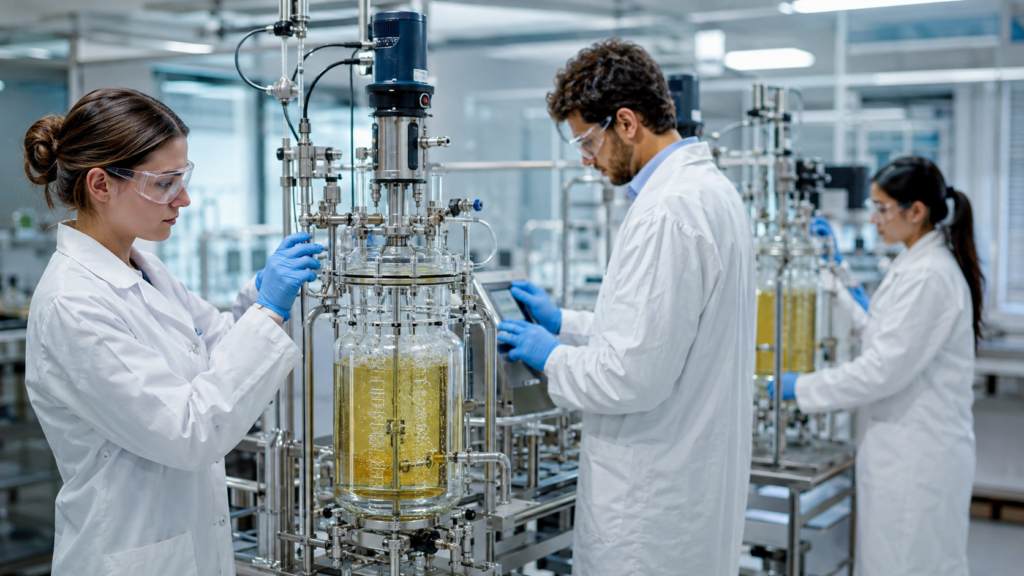
Manufacturers are testing enzymes as selective catalysts for chemical steps that traditionally require harsh conditions. The work reflects a broader change in enzyme science: researchers are connecting molecular detail with practical decisions about cost, safety and environmental impact. A promising result matters most when it can be reproduced and understood outside one laboratory.
Interest in industrial biocatalysis is growing because of engineered proteins, reusable reaction systems and improved process monitoring. These advances reduce the time between an idea and a meaningful test. They also allow teams to compare more candidates without treating every successful measurement as proof that a technology is ready for routine use.
The potential value is clearest for companies producing pharmaceuticals, flavors, fragrances and advanced materials. Enzymes can perform selective reactions under conditions that are often gentler than conventional alternatives. That selectivity may reduce unwanted by-products, simplify later purification and make entirely new products possible when the surrounding process is designed carefully.
Scientists still need to understand why a result works. Activity can change with temperature, acidity, solvents, storage and the presence of other compounds. Measuring only the strongest initial signal can hide instability that appears hours or days later. Good development programs therefore test performance across realistic conditions.
An enzyme that works in a flask may lose performance at industrial scale. Addressing that limitation requires reference materials, repeat testing and transparent reporting of negative results. Teams also need controls that distinguish true enzyme activity from changes caused by instruments, sample handling or unrelated chemistry. These safeguards slow individual experiments but make eventual applications more dependable.
Scale introduces another layer of questions. Raw materials vary, equipment creates physical stress and small changes in mixing can affect contact between an enzyme and its target. Economic assessments must include enzyme production, recovery, transport and disposal rather than focusing only on the reaction inside a controlled vessel.
The next stage will likely bring processes designed around biology from the beginning instead of added after development. Progress will not be identical across medicine, food and manufacturing, because each field has different standards and risk tolerances. Even so, collaboration between biologists, engineers and end users is making research goals more realistic.
For readers following the field, the most useful signals are replicated data, clearly defined comparisons and evidence from conditions that resemble actual use. Enzymes are powerful tools, but they are not automatic solutions. Their strongest contributions appear when molecular innovation is matched with thoughtful process design, responsible testing and honest communication about limits.


More Stories
Enzyme Biosensors Move Toward Faster Field Testing